
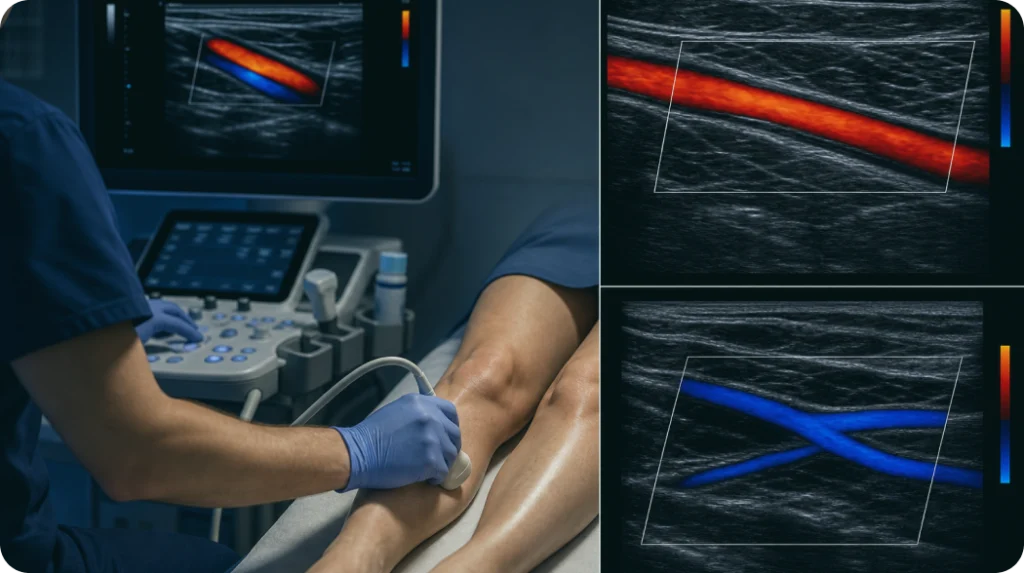
Arterial and venous ultrasound is an examination procedure that provides visual images of blood flow in all arteries and veins in the body. The procedure involves the use of sound waves to produce live images of your arteries and veins. It involves no radiation, injections and recovery time.
Your circulation has a direct way of letting you know when something isn’t quite right. Ignoring early physical cues usually only lets the underlying issue compound over time.
Common signs that may warrant further vascular evaluation include
An abdominal vascular ultrasound can be important. It is part of evaluating your cardiovascular and vascular health. Your provider can assess whether this test is appropriate based on your symptoms & medical history.
This test gives a clear window into how blood is moving through your vessels. This helps us identify a range of circulation problems before they become more complicated. Both the arterial side and the venous side can be evaluated in the same visit when needed.
Here are some of the most common conditions an arterial and venous ultrasound can help diagnose or rule out:
Narrowing or blockages in the arteries of the legs that reduce blood flow and often cause pain with walking
Blood clots that form in the deeper veins, usually in the legs, which can be serious if they travel
When the valves in the leg veins don’t close properly, leading to blood pooling, swelling, and skin changes
Areas where vessels have become narrowed by atherosclerosis
Abnormal enlargements of an artery that need monitoring or treatment if they grow
Identifying the specific veins that are feeding visible or symptomatic veins
Checking blood flow after stents, bypass grafts or other vascular treatments
The decision is always personal. Your cardiologist will weigh your symptoms and specific concerns before recommending the test.
Preparing for an arterial and venous ultrasound is simple. Most people need only a few practical steps so the images come out clear and the appointment stays comfortable.
Here is a straightforward guide to help you get ready.
If your doctor is recommending you to undergo an arterial and venous ultrasound, what does it feel like? It’s a non-invasive and entirely pain-free procedure. Here is what happens from start to finish during the procedure:
You would either be asked to put on a gown or simply expose the area that is going to be examined (usually the legs and arms). You would be asked to lay down on an examination table where the technologist would position you in a standing or sitting position to demonstrate how your valves work. All of the images would be displayed on the screen.
A water-based gel is applied on your skin which would feel a bit cold in the beginning. This is used in order for the sound waves to be transmitted clearly. Then, a small handheld probe known as a transducer would be placed on the area with gel and slid along the arteries and veins. You’ll feel mild pressure.
The movement of blood will be detected through the Doppler signals with a whooshing sound. Color images will be seen on the screen as the technologist calculates the velocity of the blood flow and the location where there is any blockage or constriction.
In the case of veins, the technologist may apply some pressure on the blood vessel using the probe to check whether the vein collapses normally, which will help in identifying blood clots. In arteries, the technologist may use blood-pressure cuffs on different parts of your legs or arms. You may also be asked to take a deep breath or briefly bear down.
Wrapping up your vascular scan is quick and getting back to your day requires zero downtime. Because the test involves no needles or radiation. you walk out of the exam room feeling completely fine and ready to resume normal activities right away.
Our board-certified cardiologist, Dr. Tanveer Ahmed meticulously analyzes the recorded blood flow patterns and valve functions captured during your session. We reach out to walk you through the results clearly. The specialist outlines clear next steps depending on what the scan uncovers.

Choosing where to have an arterial or venous ultrasound matters. At Premier Choice Cardiology, these exams are performed in a fully accredited vascular laboratory at our Lakewood and Brick offices. You benefit from modern ultrasound equipment, experienced technologists, and direct oversight by Dr. Tanveer Ahmad, MD, FACC.

If leg pain, swelling, or circulation worries have been on your mind, you don’t have to figure it out alone. At Premier Choice Cardiology, we are here to give you clear answers with arterial and venous ultrasound. All tests are performed right in our accredited labs by a team that truly listens.

Not at all. You’ll feel the technologist moving a small probe over your skin with some cool gel. Most people say it’s completely comfortable.
The whole session is usually 30 to 45 minutes. The time depends on which vessels we’re looking at. You’ll be in and out without a long wait.
Dr. Ahmad reviews every study himself. In most cases you’ll hear from us within a day or two. And we will go over everything in plain language.
Yes. We offer arterial and venous ultrasound at both our Lakewood and Brick locations so you can choose what’s most convenient.
Yes completely safe. These tests use only sound waves. There’s no radiation or no contrast dye in most cases. There are no known side effects.