When your heart feels a little off, maybe a strange flutter you can’t quite ignore, a racing pulse, or unexpected chest discomfort, getting reliable answers is the only thing that matters. At Premier Choice Cardiology, an electrocardiogram is almost always the very first step we take to figure out exactly what’s happening with your heart.

Pinpoints the exact cause of skipping, racing or fluttering rhythms and including conditions like AFib.
Uncovers scar tissue from previous "silent" heart attacks that you might not have realized happened.
Spots the early warning signs of coronary artery disease even if you aren't actively feeling chest pain.
Identifies delays in your heart’s internal wiring before they trigger more dangerous rhythm issues.
Detects an enlarged heart. It is often the result of untreated high blood pressure.
Reveals dangerous dips or spikes in essential minerals that disrupt how your heart naturally beats.
Heart problems are hidden. Sometimes, your heart functions perfectly while you are sitting down in a doctor’s office, only to go completely out of control when you are doing some work. Here are a few different versions of the test.
This is the classic version. You lie flat on a table, we hook up the wires and we record your heart while you do absolutely nothing. It takes less than five minutes.
A resting test won't help us much if your chest only hurts when you are pushing yourself. For a stress test, we hook you up to the EKG monitor and then put you on a treadmill or a stationary bike. We want to see exactly how your heart's electrical system handles the strain of exercise.
What if your heart only skips a beat randomly at 2:00 PM on a Tuesday? We use a Holter monitor to catch that. This is a portable and battery-operated ECG device that you wear under your shirt for 24 to 48 hours. It records every single heartbeat while you sleep and work.
Wearing a monitor for a day isn't enough if your symptoms only happen once every few weeks. An event monitor is worn for up to a month. It doesn't record constantly. Instead, when you feel a dizzy spell or a chest flutter coming on, you push a button to tell the device to start recording the episode.
A standard ECG usually requires little preparation. A few simple steps can make the appointment more comfortable and help the electrodes record clear signals.
You’ll step into a private room and change into a clinic gown. We make sure you stay properly covered. Only baring the exact spots we need to reach on your chest.
Once you lie back on the exam table, our technician will quickly wipe a few areas with an alcohol pad.
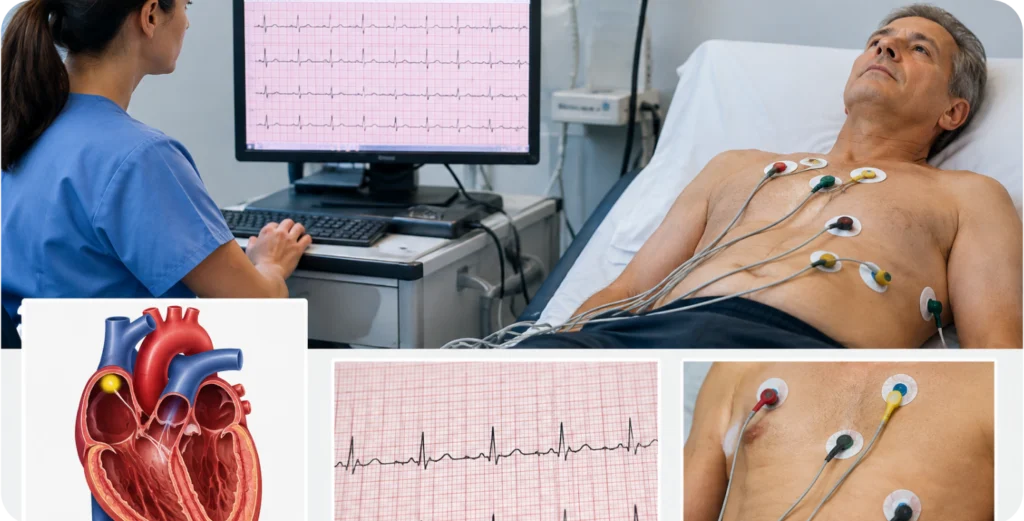
We press ten little sticky patches onto your skin. Six go right across your chest & the others go on your arms & legs. After that, we just clip the soft monitor wires onto the stickers.
You just stay relaxed and breathe normally. We will ask you to hold off on chatting or shifting around for a few seconds because any muscle twitching can blur the doctor's reading.
The EKG machine quietly maps out your heart's electrical signals from a few different angles. You won't feel a single thing. There are no shocks and absolutely zero discomfort.
The test is over in no time. We peel off the patches and wipe away any leftover stickiness and let you get dressed.
An electrocardiogram is a safe and noninvasive test with no major risks or danger of electric shock. An ECG does not put any electricity into your body. Zero. None. You will not feel a tingle or any heat.
The absolute worst side effect you might experience is a little bit of red or irritated skin when we peel the adhesive patches off at the end of the test.
There is no recovery time. You can grab your car keys and go back to the home or office right after the test.
We usually have the results right away because the machine generates the graph instantly. A cardiologist from Premier Choice Cardiology might come into the room to discuss the test results with you immediately.
We use highly sensitive, modern EKG machines to capture a flawless reading of your heart rhythm on the very first try.
If you live in Ocean or Monmouth County, save yourself the long drive. We offer exceptional cardiac care right in your own yard.
Our board-certified cardiologists will do a detailed discussion with you related to your health. We take the time to explain exactly what your test results mean for your everyday life.
We will sit and answer every single one of your questions until you feel completely confident in your game plan moving forward.
Stop wondering why your chest feels tight. Stop worrying about that skipped beat you felt last night.
No real difference. ECG stands for electrocardiogram while EKG comes from the German spelling “Elektrokardiogramm.” Both mean the same test.
Yes. You can follow your normal routine with food and drinks unless your doctor gives different instructions for a related test.
Sometimes a small patch of hair is clipped or shaved so the electrodes make good contact. It’s quick and only done if necessary.
Yes. Just make sure the technician knows you have one. The test itself doesn’t interfere with these devices.
Most insurance plans cover it when ordered for a medical reason. It’s always a good idea to check with your specific plan if you have questions about coverage.