Even though AFib is common, it should not be ignored because an irregular heart rhythm can lower the heart’s efficiency and may increase the risk of blood clots and stroke.
At Premier Choice Cardiology, we examine your symptoms, medical history, and the appropriate cardiac tests in order to evaluate your AFib and other heart rhythm disorders; our goal is to understand your condition, identify the factors which may affect your heart health, and then prepare a treatment and follow-up plan in line with your individual needs.

Atrial fibrillation may have a variety of causes, and in some instances there is no one particular cause; it occurs when conditions that affect the heart or general health change the heart’s normal rhythm.
If you know the factors which may be causing AFib, this will enable your cardiologist to understand your condition better and to decide on the most suitable method of caring for you.
At Premier Choice Cardiology, our cardiologists use one or more of the following:
It is used to record the electrical activity of the heart and detect irregular rhythms.
It is a device that can be taken anywhere and which continuously records your heart rhythm; it is usually used for a period of 24 hours or more.
It can be used when the symptoms occur less frequently by recording your heart rhythm over a longer period.
The heart's structure and function can be imaged by means of sound waves and then assessed.
It will depend on your symptoms and medical history; the cardiologists at Premier Choice Cardiology might suggest further tests in order to get a better understanding of your heart health.
Treatment of Atrial fibrillation depends on your symptoms, what type of AFib you have, your overall health, & your complications. Treatment & management include:
Blood thinners are medicines that help reduce the chance of blood clots forming. For some people with AFib, they may be recommended because AFib can increase the risk of blood clots and stroke.
The left atrial appendage is a small pouch in the heart where blood clots can sometimes form in people with AFib. In selected patients, closing this area may help reduce stroke risk, particularly when long-term blood-thinning medication is not suitable.
A minimally invasive surgical approach, sometimes called keyhole ablation, uses small openings in the chest to reach the heart. It may be considered for selected patients with persistent or difficult-to-treat AFib.
When AFib is very difficult to control, or another heart surgery is being performed, surgical ablation is an option for some patients. A surgeon creates areas of scar tissue to help block abnormal electrical signals.
Catheter ablation is a procedure in which thin, flexible tubes are guided into the heart to target tissue responsible for abnormal electrical signals. It may be considered when medications do not adequately control AFib or as an initial treatment option for selected patients.
During your visit at Premier Choice Cardiology, your AFib care starts with understanding your symptoms and your overall heart health. Dr. Tanveer Ahmad, MD, will take care of your testing, treatment, and follow-up based on individual patients’ needs.
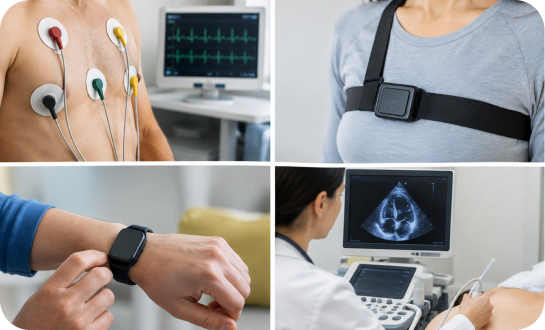
AFib evaluation may include an ECG/EKG, Holter monitoring, event monitoring, or echocardiography, depending on the symptoms and their frequency.

Dr. Tanveer Ahmad provides treatments that are important for your health because he says that every patient faces different issues, so a standard plan does not fit all.

Regular follow-up helps your cardiologist monitor your symptoms, treatment response, and heart rhythm and make changes when needed.
Choosing the right cardiologist matters when you are dealing with an irregular heart rhythm. Premier Choice Cardiology combines experience in cardiovascular care with a patient-focused approach to AFib evaluation and treatment.
Dr. Tanveer Ahmad, MD, has over twenty years’ experience in cardiology and has received training in both cardiovascular and interventional cardiology.
His areas of expertise include atrial fibrillation and flutter, cardiac arrhythmias, sick sinus syndrome, and other rhythm-related conditions.
AFib can occur alongside conditions such as hypertension, coronary artery disease, and other cardiovascular problems. A broader evaluation can help put your heart rhythm in context.
Patients have recognized Dr. Ahmad for listening carefully, explaining clearly, and taking time with their concerns.
Timely appointments and a completely hassle-free experience for our neighbors across Ocean and Monmouth Counties.
Premier Choice Cardiology has offices in Lakewood and Brick, NJ. This makes it easier for patients in Ocean and Monmouth Counties to see a cardiologist close to home. Pick the location that’s most convenient for you and reach out to our team to book your appointment.

A wide range of insurance plans are accepted to ensure expert heart care is always accessible and stress-free.








AFib must not be ignored even if the symptoms appear and disappear. Proper evaluation will help you understand your heart rhythm and the treatment options available to you.
AFib can increase the risk of blood clots and stroke. It may also contribute to heart failure in some patients. The level of risk varies, so a cardiologist should assess your condition and recommend appropriate treatment.
Some types of AFib can start and stop on their own, while others may continue for longer periods. Even if your symptoms disappear, it is important to discuss recurring episodes with a
cardiologist.
AFib can often be managed with medication and procedures such as catheter ablation. Some patients maintain a normal heart rhythm after treatment, but AFib can return. Ongoing follow-up and stroke-risk assessment may still be necessary.
An ECG/EKG can detect an irregular heart rhythm. Your cardiologist may also recommend a Holter monitor, event recorder, echocardiogram, or other cardiac testing based on your symptoms.
See a cardiologist for new, recurring, or unexplained irregular heartbeats, especially if they occur with dizziness, shortness of breath, chest discomfort, or fatigue.