Do your legs ever feel unusually heavy, tight, or painful when you take a simple walk? Many people just write these cramps off as a normal part of aging. You sit down to rest for a few minutes, the pain fades away, and you move on with your day. But if that cycle sounds familiar, you really shouldn’t ignore it. That specific type of recurring leg discomfort is actually a major red flag for Peripheral Arterial Disease.

Peripheral arterial disease testing checks how well blood moves through the arteries in your legs and feet. The goal is to spot any narrowed or blocked arteries that are usually caused by plaque buildup.
Peripheral arterial disease often develops silently in the background. Recognizing your personal risk factors is the best way to stay ahead of serious vascular issues.
You should consider a non-invasive screening if you:
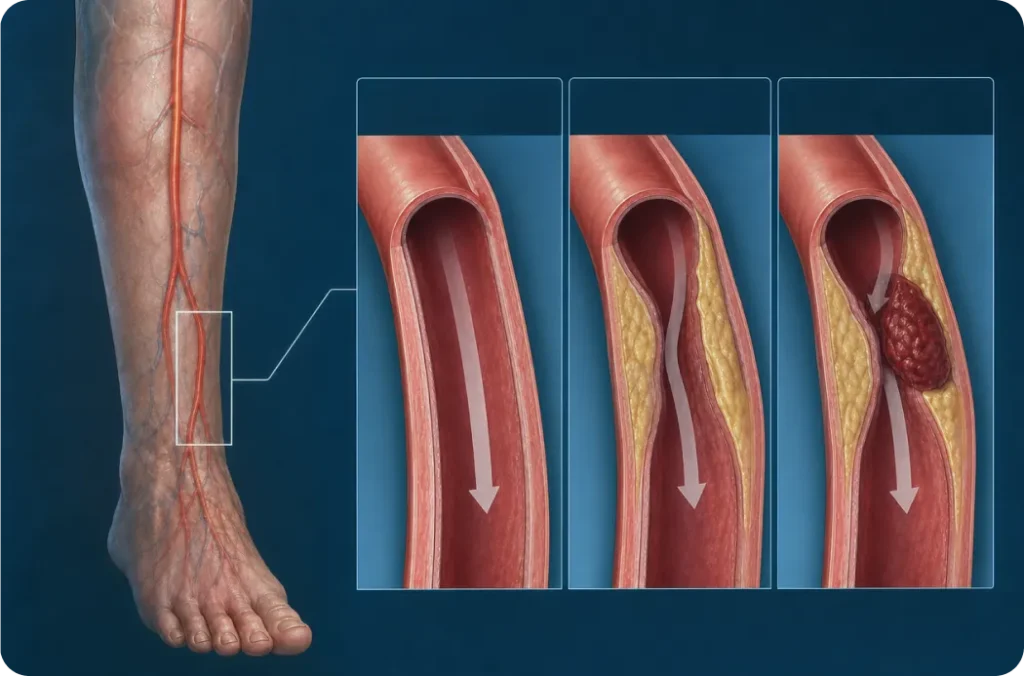
Certain lifestyle habits and underlying health conditions dramatically increase the likelihood of plaque buildup in your lower extremities. You are at a higher risk for developing PAD if you have any of the following:
The following are some of the problems that can be discovered by a carotid duplex
Having one or more of these risk factors does not mean you will definitely develop peripheral artery disease. But it does mean a conversation with your healthcare provider is worthwhile.
Here is a look at the specific screenings our specialists use to map out your vascular health and get to the root of your symptoms
Think of the Ankle-Brachial Index as our gold-standard starting point. The process is incredibly straightforward and completely painless. Using a standard blood pressure cuff paired with a specialized ultrasound device, we measure the resting blood pressure in your arm and compare it directly to the pressure down at your ankle. In a healthy circulatory system, those two numbers should be nearly identical. If the pressure in your ankle is noticeably lower, it is a strong indicator that plaque buildup is restricting blood flow somewhere along the path.
For some patients, the blood vessels in the ankles can become heavily calcified and rigid. When those arteries harden, standard ABI blood pressure readings can become artificially inflated and inaccurate. To get around this, we perform a Toe-Brachial Index. By placing miniature blood pressure cuffs right on your big toes, we can measure circulation at the very end of your extremities, where the smaller vessels are much less likely to be stiffened by calcium deposits.
If your initial ABI points to a drop in blood pressure, our next job is to find out exactly where the plaque is located. Segmental pressure testing acts like a roadmap for your legs. We will place three or four blood pressure cuffs at different levels along your lower body and right above the ankle. By taking readings at each distinct segment, our cardiology team can pinpoint the precise location of a narrowed or blocked artery.
While blood pressure cuffs give us the raw numbers, Pulse Volume Recording and Doppler technology give us the complete visual story. PVR measures the actual volume of blood surging through your legs with every single heartbeat. Meanwhile, Doppler ultrasound translates your blood flow into visual waveforms on a screen. Together, these tools let our specialists actually “see” the rhythm, speed, and efficiency of your circulation in real-time, giving us the exact data we need to design a treatment plan that gets you back to living comfortably.
Hearing that your test results are abnormal can feel scary. But it is actually the first empowering step toward finding real relief for your leg pain. An abnormal score simply gives us an actionable picture of exactly where your circulation is struggling.
Once your screening is complete, your tests will be thoroughly analyzed by Dr. Tanveer Ahmed. Dr. Ahmed will personally sit down with you to explain the findings in plain English and expertly guide you through the best next steps. He will design a personalized care plan to safely restore your blood flow and get you back to moving comfortably.
Dr. Tanveer Ahmed will design a customized roadmap for your recovery depending on the severity of your blockages. Here is a look at the most common ways we successfully treat PAD:
Peripheral arterial disease testing can provide valuable information about circulation in your legs and feet. Here is why this test makes such a big difference:
We can spot poor blood flow way before the pain gets intense.
It proves if your cold toes or walking cramps are actually coming from narrowed arteries
Getting ahead of the problem keeps you walking easily every day.
Leg blockages often point to a higher stroke risk, so finding them early helps protect your entire body.
Your doctor uses these numbers to figure out if you just need a few habit tweaks, some medication, or extra checkups.
Taking action early stops scary complications down the road, like foot sores that refuse to heal or severe limb damage.
At Premier Choice Cardiology, we combine clinical expertise with a genuinely patient-first approach to make your screening comfortable and straightforward. We utilize state-of-the-art ultrasound equipment and precision testing tools to map your blood flow accurately without invasive procedures. All of our vascular testing is performed at our accredited facility at Lakewood & Brick. Your health isn’t left to guesswork. Dr. Tanveer Ahmed and our experienced team carefully evaluate every test to design a personalized treatment plan that keeps you moving comfortably.

Ready to get answers about your leg pain and protect your circulation? Don’t wait until discomfort slows you down.
Call our office today at Premier Choice Cardiology or book your evaluation online to schedule your Peripheral Arterial Disease testing with Dr. Tanveer Ahmed. Let us help you get back on your feet comfortably.

Most visits last 30 to 60 minutes depending on which studies are needed. You can usually drive yourself home and return to normal activities right away.
Not at all. The standard diagnostic tests we perform are entirely non-invasive. You might feel a brief squeeze from a blood pressure cuff only.
Yes. The disease can progress quietly for years. That’s why testing is recommended for anyone with strong risk factors.
Not at all. They simply record the pattern and strength of blood flow using cuffs and a small ultrasound probe. You’ll hear a soft whooshing sound.
A score below 0.90 points to moderate or severe PAD. It confirms that narrowed arteries are actively restricting blood flow.