
Some heart rhythm problems are difficult to catch because they do not happen every day. Standard short-term monitors often completely miss them. An Implantable Loop Recorder changes that.
At Premier Choice Cardiology, we offer ILR monitoring for patients across Lakewood, Brick, and surrounding areas in New Jersey who require continuous and long-term heart rhythm tracking. Think of it as a 24/7 internal safety net. The device itself is smaller than a typical thumb drive and sits just beneath the skin of your chest. Getting it placed is a straightforward outpatient procedure and it can stay quietly on the job for up to three years.

An implantable loop recorder runs quietly beneath your skin without daily maintenance. Here is how it captures the heart data standard tests miss:
The device functions like a tiny, 24/7 electrocardiogram. Sitting comfortably on the left side of your chest, it constantly checks your heart’s electrical activity while you sleep, work, or exercise.
The monitor automatically stores data if your heart rate spikes or goes into an abnormal rhythm. You also receive a handheld activator to press whenever you feel dizzy or notice a flutter. This manually captures the exact moment your symptoms happen.
A bedside monitor or smartphone app securely transmits those saved recordings directly to our cardiology team. We review the data remotely. The data allows us to diagnose the issue quickly without requiring frequent clinic visits.
Short-term heart monitors work well when symptoms happen every single day. An implantable loop recorder provides the extended window needed to catch symptoms that happen infrequently.
Cardiologists frequently use an ILR to evaluate & diagnose:
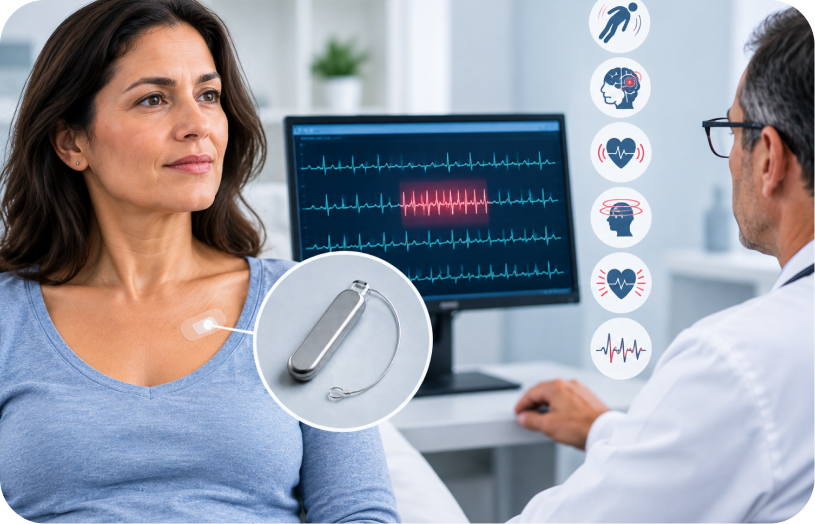
Not every patient needs an ILR. Cardiologists typically consider an ILR when symptoms are infrequent and haven’t shown up on shorter-term monitors like Holters or 30-day event recorders.
You may be a good candidate for an ILR if you:
| Preparation Area | Typical Guidance |
| Medications | Take most as usual; follow specific instructions for blood thinners |
| Eating & Drinking | Follow your center’s rules (light meal or short fasting) |
| Hygiene | Shower night before & morning of; no self-shaving or lotions on chest |
| Clothing & Belongings | Loose front-opening clothes; leave jewelry at home |
| Transportation | Arrange a ride home if possible |
| What to Bring | Medication list, ID, insurance card, something to occupy waiting time |
Hearing the word “implant” might sound intimidating. But placing an ILR is actually a very minor process. The actual placement takes about 10 to 15 minutes right here in the clinic.Also, our cardiologist Dr. Tanveer Ahmed makes the whole process simple
We start by cleaning your upper chest and injecting a strong local anesthetic. You will stay fully awake. We can offer a mild sedative to keep you relaxed if you feel overly anxious.
Your cardiologist makes a very small cut once the area is completely numb. The cut is usually less than half an inch. You might feel some firm pressure or pushing. But you won't feel any sharp pain.
The doctor uses a specialized tool to gently slide the device just under the surface of your skin. It sits very shallow in a tiny pocket and never touches your heart muscle.
We close the small opening with medical skin glue or a couple of stitches. Next, we place a sterile bandage over the area to keep out bacteria while the skin heals.
You will rest in our clinic for roughly 30 minutes while we make sure the device connects properly. We will show you exactly how to use your symptom remote and then you are free to leave. Just make sure you bring someone along to drive you home.
Recovery after getting a loop recorder is incredibly fast. Most people feel entirely like themselves within a day or two. Your main focus is just protecting that small chest incision while it heals.
Keep the site dry for the first 48 hours. That means skipping showers and swimming pools for at least a week. A little bruising or tenderness is completely normal.
ILR is widely considered one of the safest diagnostic procedures in modern cardiology. Still a few minor side effects can occasionally show up.
Potential risks and minor complications include:


An implantable loop recorder can be functional for two to four years. This can depend on the type of device model and the period for which the battery of the recorder can last.
Some recorders work continuously for three years. Some newer models can last for four to five years or six years maximum.
Premier Choice Cardiology in Lakewood & Brick is led by board-certified cardiologist Dr. Tanveer Ahmad. The practice focuses on thorough evaluations and practical solutions personalized to each person’s needs.
Here is what makes our practice different:
Dr. Ahmad is a renowned board-certified cardiologist with a strong track record managing cardiovascular conditions.
Driving all over town for different heart tests is a massive headache. So we built a fully accredited diagnostic lab right inside our clinic.
We focus heavily on keeping you healthy and out of the hospital. But if you do need acute care, our team steps in to coordinate directly with local hospitals.
If you ask our current patients what they love about the clinic, the answer is almost always the same. We listen. We take our time carefully managing your condition.
Our practice provides full-spectrum services that cover all aspects of monitoring, along with special procedures like implanting a loop recorder.
Yes when your doctor determines it’s medically necessary. Coverage can vary by plan. Our team can help verify your benefits.
The cost will vary depending on your type of insurance your deductible, and the particular place where this procedure will be performed.
It records automatically when it detects certain rhythm changes. You can also press a button on a small activator if you feel symptoms.
The device sends your rhythm logs wirelessly through a bedside transmitter or a secure app on your smartphone while you sleep. Our clinic reviews those reports remotely.
Many modern devices are MRI-conditional. Your doctor will confirm whether yours is safe and under what conditions.