Your heart might look completely perfectly fine while you’re just sitting in a chair. But what happens when it actually has to do some real work? That’s exactly what an Exercise Treadmill Test helps us figure out.
At Premier Choice Cardiology, we use this specific physical evaluation to see how your cardiovascular system handles the real-world stress of walking. You step onto our clinical treadmill and we start off at a very relaxed pace that slowly gets steeper and faster. Our specialists keep a close watch on your blood pressure, breathing rate, and electrical heart rhythms.

An exercise treadmill test is a noninvasive heart test that shows how your cardiovascular system responds when you become more active. Your cardiologist monitors its activity as you walk on a treadmill and your level of exertion gradually increases. The purpose is to uncover changes that may not appear while you are sitting still.
An exercise treadmill test helps your cardiologist see how your heart responds when physical activity increases its workload. Your doctor can look for signs that may not be apparent when you are sitting or lying down.
This real-time physical evaluation helps our cardiologists figure out a few major things about your heart health:


A cardiologist usually suggests an exercise treadmill test when symptoms or risk factors raise questions that a resting ECG or office visit alone cannot fully answer. The goal is to see how the heart performs under real physical demand rather than guessing from history alone.
Your doctor may suggest this test for several reasons:
Getting ready for your treadmill appointment really isn’t complicated at all. But a few small tweaks to your morning routine can make a massive difference in the accuracy of your EKG readings.
Here’s a clear overview of the usual instructions:
| Timing | What to Do | Why It Matters |
|---|---|---|
| 24 hours before | Avoid all caffeine | Caffeine can affect heart rate and blood pressure readings |
| 3–4 hours before | Do not eat a heavy meal; water is fine | Reduces the chance of nausea during exercise |
| Day of the test | Wear comfortable clothes and sneakers or walking shoes | You need to move freely on the treadmill |
| Day of the test | Skip lotions, oils, or powders on your chest | Electrodes stick better on clean, dry skin |
| Day of the test | Bring a full list of your medications | Helps the team know exactly what you’re taking |
It is completely normal to feel a bit anxious before your first appointment. But honestly? The process is incredibly straightforward and our team stays right by your side. Here is exactly what happens.
First, you change into a hospital gown or simply keep your loose gym shirt on. Next, we stick small electrode patches across your chest. We might need to shave a tiny spot for a better grip. We also grab your baseline resting blood pressure.
You step onto the belt and we start things off at a very slow pace usually under two miles per hour. Our clinical staff stands right next to you and talks you through it step by step.
The belt speeds up every three minutes and tilts upward to simulate climbing a hill. We do this to safely push your heart rate higher and watch how your heart responds. Most people only end up walking for about eight to twelve minutes.
We constantly track your live EKG and blood pressure while you walk. We will frequently ask how you are holding up. Our team is right with all time if you feel dizzy or just need a break. We can stop the test immediately.
We customize your new settings based on the data we just pulled and a discussion of your symptoms. The device is then checked again to confirm that the updated settings are working as intended.
Most exercise treadmill test appointments take about 30 to 45 minutes from start to finish. The actual time you spend walking on the treadmill is usually much shorter. It is often around 10 to 15 minutes. The rest of the appointment which includes preparation, monitoring, and recovery, also takes time.
Plan to arrive a little early so there is time for check-in and preparation. You can usually return to your normal routine afterward.
The biggest question on patients’ minds after the exercise treadmill test is the results.
Our cardiologist might give you a quick overview of how things looked before you even walk out the door. Other times, we prefer to take a day or two to sit down and deeply analyze the complex EKG readouts before giving you a final verdict.
When your doctor does sit down to explain your results, they will generally fall into one of two categories.
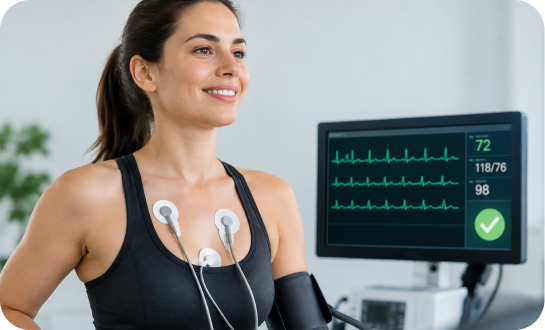
This is the green light you want to hear. A normal result basically means your cardiovascular system handled the physical workload exactly like it is supposed to. Your blood pressure rose naturally. And the EKG didn't pick up any warning signs.
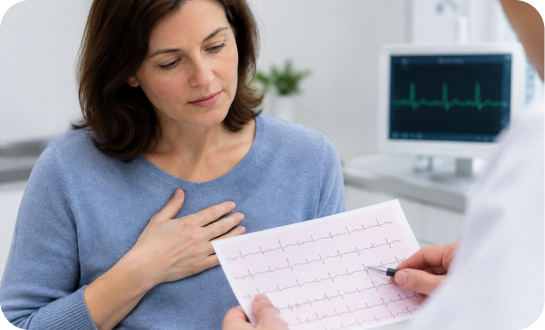
An abnormal or positive result may include ECG changes. If your test comes back abnormal, take a deep breath. A positive result definitely does not mean you are in immediate danger. These findings can suggest reduced blood flow to the heart muscle or another issue that needs closer evaluation.
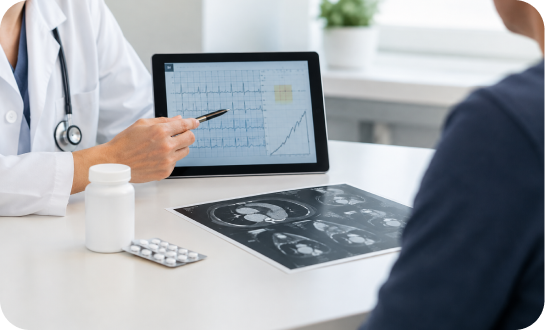
An abnormal ETT is really just a diagnostic roadmap. It tells us exactly where to look next. We might just need to modify the dosage of your daily blood pressure medication based on the findings. Or we might schedule a more detailed imaging exam.
A treadmill GXT allows your cardiologist to assess how your heart responds as physical activity gradually becomes more demanding. The test can provide useful information to help guide your cardiac care.
Key benefits include:
An exercise treadmill test is generally very safe. Serious complications occur in fewer than 4 out of every 1,000 tests.
It carries some temporary symptoms like any other medical procedure. The minor risks include:
Serious events or risks are very rare. They occur in less than 0.2% to 0.1% of procedures. Rare complications are:
Choosing a cardiology practice comes down to trust. Premier Choice Cardiology combines decades of hands-on experience with a patient-first approach. Here is why patient trust us:

Quitting tobacco, eating a diet rich in fruits, vegetables, and whole grains, exercising regularly, and losing 3–5% of body weight can help manage PAD and slow its progression.

Proper medication is required if you have any symptoms or complications of peripheral artery disease.

These medicines are used to help lower bad cholesterol. They help reduce plaque buildup in the arteries. Statins also lower the risk of heart attacks and strokes.

Clear communication is very important. We believe you should understand why a test is recommended & what it involves.

Our offices are located right in Lakewood and Brick. Patients throughout Ocean and Monmouth counties can get top-tier heart evaluations close to home.
In case your pacemaker needs to be checked or you have some new symptoms, do not procrastinate. Our specialists from Premier Choice Cardiology will check your pacemaker and will readjust the settings if required.
Contact us or fill out our online form to book an appointment for reprogramming of your pacemaker.
Not exactly. A standard ECG records your heart’s electrical activity while you are generally resting. An exercise treadmill test uses ECG monitoring during physical activity.
We usually start you off around 1.7 miles per hour. It is practically a slow crawl just to get you used to the belt. It gradually speeds up. But rarely goes over 3 or 4 mph for the average patient.
It almost never happens. Our clinical team stands literally inches away from you the entire time. The machine also has an emergency safety stop.
Yes. Insurance providers consider it a necessary diagnostic if you are having shortness of breath or need clearance for a surgery. Our billing team always verifies your coverage beforehand.
Sometimes we can give you a rough idea right there in the room. But the doctor normally takes a day or two to thoroughly analyze the complex EKG data.